
Central vacuum cleaning systems in Monmouth and Ocean County, NJ are built-in, centrally located vacuums, as the name implies: vacuum cleaners built into your structure like a water heater or any other appliance.
A common myth is that central vacuums can only be installed in new structures. That is the ideal time, but they’re quite easy to retrofit into most structures, especially if they’re up to code.
Benefits of central vacuum cleaning systems
First, they’re the most technologically advanced vacuum cleaners out there. Second, they’re more powerful, with their own dedicated circuit.
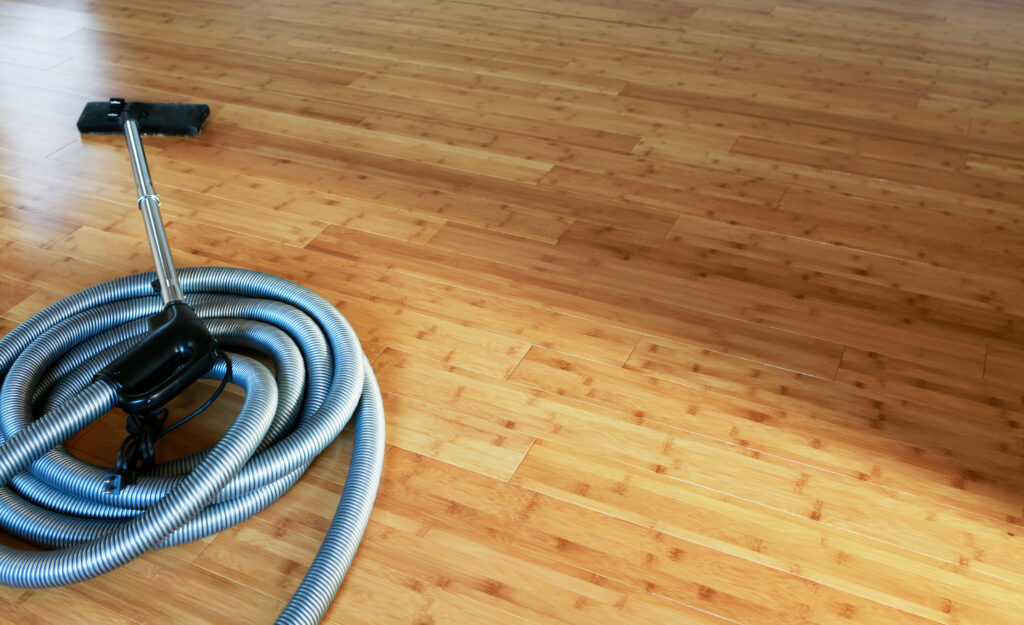
Central Vacuum Cleaning in Monmouth & Ocean Counties, NJ
Third, maneuverability and convenience: these are a lot more maneuverable. Fourth is air quality, because all the air is vented outside the living space.
Air Quality
With a portable vacuum, the air goes in and then out into the living space. With a central vacuum, the air is sucked through a pipe into the collection unit with the motor, then out of the living space, a lot of times vented straight out of the house. None of that dust goes back into the room, a big difference for allergy sufferers.
Noise
Because the motor is out of the room, really all you hear is the airflow. Pretty darn quiet, a drastic difference from a portable vacuum like a Dyson. Right next to the unit in the garage is louder, but that’s outside the living space.
The Retractable Hose
When you’re done, the hose retracts into a raceway, back into the wall on a modern installation. The hose can be up to 60 ft, basically one hose per 2,000 square ft when placed properly, typically one per floor; a really big house might have two or three. It’s pretty convenient to just pull that hose out of the wall.
Convenience and Maneuverability
You’re not hauling a whole vacuum cleaner around, only the attachments and the hose, like 2 to 4 lb versus even a lightweight vacuum cleaner at 8 lb. A cordless stick vacuum still means carrying a motor that’s 5 to 10 lb. Far more convenient and maneuverable than anything else on the market.
Accessories
Because they’re an inch and a quarter, the world is your oyster in terms of accessories. Make sure you have one set for each floor, and ask your installer about the remote control handle that doesn’t require batteries.
Performance and Suction Power
Because you don’t have to carry the motor, it can be any size and shape: more than one motor, three fans, sometimes a motor as big as a portable vacuum by itself, looking like a trash can on the garage wall and running off a dedicated circuit, either 110 volts or 220. The possibilities are endless, and it leaves the engineers to design what works best.
Sizing the Power Unit for Your House
These units are sized to the house: a 2,000 square ft house is buying a different power unit than a 5,000 or a 10,000 square ft house. Most units are sized at sea level for an old school installation, and with modern retract hoses and altitude, they’re 40% less.
That’s where your local expert in Monmouth and Ocean County, NJ, will come in; you don’t just buy any one off the internet and slap it on your walls. Builder-grade houses that weren’t sized properly end up with a weak central vacuum.
The Retrofit Process
Retrofitting is actually pretty easy in most houses in Monmouth and Ocean County, NJ. The power unit needs a dedicated circuit, so it goes next to the circuit breaker box in the garage or utility room. Most houses have an attic, a crawl space, or an unfinished basement, so the piping goes in through those spaces, usually a 1 to 2-day process.
Installation Options
Hybrid Installation
Sometimes a hybrid install is done: retractable hose valves in the main areas, and in an area used less often, like a basement or storage area, you pull the hose out of the wall and plug it into a port. That keeps reaching in spaces you don’t use as often and saves a little bit of money.
Garage, Laundry Room, and Kitchen Valves
Other conveniences: a retractable hose in the garage for cleaning out the car, a spot in a laundry room or utility room for quick messes, and a hose valve in the cabinet under the sink for a quick pickup in the kitchen.
What to Avoid
Dust Pan Installations
The number one thing is a dust pan, left over from the 80s: turn the central vacuum on and sweep dust into the system with a broom. That pulls the dust in, but it also stirs up a lot of dust; brooms are archaic and barbaric.
The modern valve under the kitchen cabinet has a set of tools inside it. If an installer suggests a dust pan, consider your other contractor options.
Traditional Valves
Traditional valves don’t make any sense anymore. The hose weighs twice as much as the retractable hoses and has a high voltage and a low voltage running through it, so there’s more to go wrong, and you have to plug it in. Done properly, it’s more expensive because an electrician has to run that high voltage.
Maintenance
These things don’t require a lot of maintenance. Most of the modern central vacuum cleaning systems have a vacuum bag that you change once or twice a year and throw away. The bag acts like a trash compactor: really dense, sealed up so you don’t have to breathe the dust.
Bagless central vacuums put everything into a canister you have to dump, with gloves and a mask, real messy, and they need maintenance at least once a month, often with a filter to clean. Make sure you’re getting a bagged unit.
Conclusion
Central vacuum cleaning systems are more powerful, more maneuverable, quieter inside the living space, with the best air quality of any vacuum cleaner. Easy to retrofit, sized to the house, easy to maintain with a bagged unit. Call your local installers in Monmouth and Ocean County, NJ, look at the reviews, and step up to a central vacuum.


