
Before you call for a dryer repair, look at the vent. When the vent that carries hot, wet air out of the house fills up with lint, the dryer has nowhere to push that air, so loads take forever and the machine runs hot.
The good news is a clogged vent usually tells on itself. Most of these signs you can check in five minutes without a single tool. Here are the seven to look for, and what each one is telling you.
The 7 signs at a glance
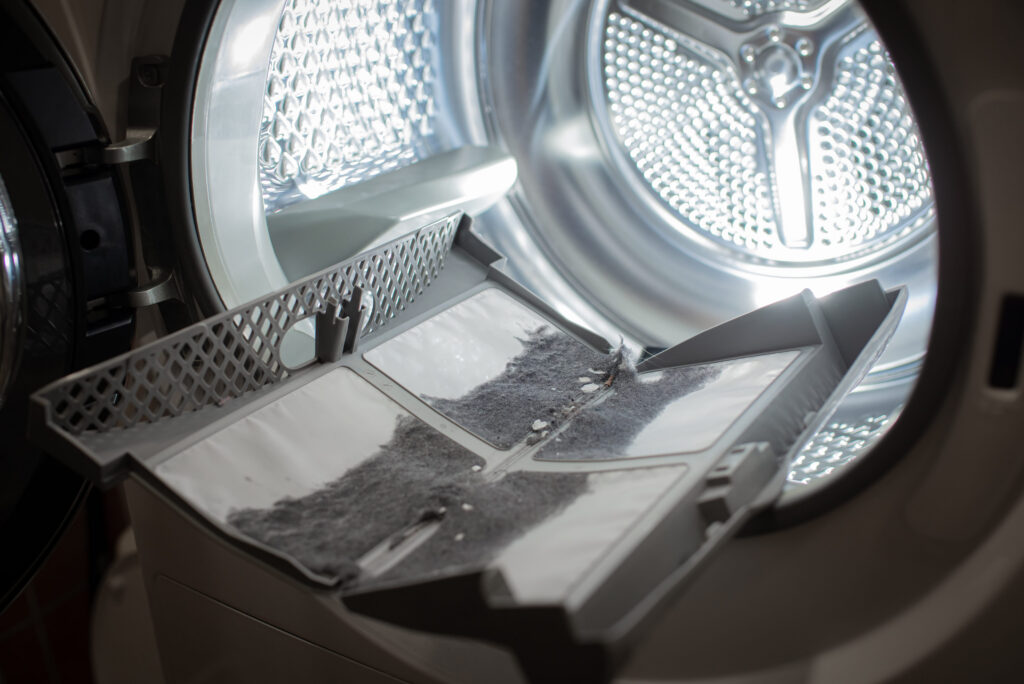
Is Your Dryer Vent Clogged?
| Sign | What you’ll notice | Quick check |
| 1. Second cycles | Normal loads still damp | Time a regular load |
| 2. Weak air outside | Little or no airflow at the hood | Go outside while it runs |
| 3. Heat | Dryer top and laundry room hot | Touch the top mid-cycle |
| 4. Empty lint screen | Screen clean after a full load | Check right after a cycle |
| 5. Lint where it shouldn’t be | Fuzz behind the dryer or on the hood | Pull the dryer out |
| 6. Crushed duct | Foil or plastic hose kinked flat | Look behind the machine |
| 7. Blocked hood | Nest, debris or a stuck flap | Look at the outside vent |
1. A normal load needs a second cycle
Easy to spot. Towels that used to come out dry in one cycle now need two. Jeans still feel damp at the waistband.
The Consumer Product Safety Commission (CPSC) calls out both of these, clothes still damp at the end of a typical cycle and drying times longer than normal, as signs of a possible blockage. The wet air from the drum has to go somewhere, and a blocked vent leaves it with nowhere to go.
2. Barely any air at the outside vent
Run the dryer and walk outside to the vent hood. You should feel a steady push of warm air, and the flap should be open.
Barely a breath? Flap hanging shut? CPSC says to check the outside vent while the dryer is running to make sure exhaust air is escaping. If it isn’t, the vent or the duct may be blocked somewhere between the machine and the wall.
3. The dryer and the laundry room feel too hot
Put your hand on top of the dryer halfway through a cycle. If it’s much hotter than it used to be, that heat isn’t getting out where it should. Same if the laundry room turns into a sauna every time you run a load.
Clothes that come out hot and damp at the same time are part of this pattern too. We list all of these in our FAQ as reasons to have the vent looked at.
4. Your lint screen looks clean after a full load
This one is backwards, so it confuses people. A clean lint screen sounds like good news.
It isn’t, if you just dried a big load of towels. In our FAQ, we list “no lint on the removable lint screen” as a sign of a clogged exhaust vent.
5. Lint is showing up in the wrong places
Lint belongs on the screen. Not on the floor behind the dryer, and not stuck around the outside hood.
CPSC recommends cleaning behind the dryer because lint builds up there. If you pull the machine out and find a carpet of it, or you see fuzz clinging to the siding around the vent outside, something may be leaking or backing up along the way.
6. The duct behind the dryer is crushed or kinked
Slide the dryer out and look at the hose connecting it to the wall. Is it shiny foil or white plastic, the accordion kind? Is it squashed flat against the wall?
CPSC says the flexible plastic or foil duct traps lint more easily and gets kinked or crushed more often, which can cut airflow by a lot. It recommends swapping it for rigid or corrugated semi-rigid metal duct.
7. Something is blocking the outside hood
The hood outside is the end of the line, and it collects more than lint. Bird and rodent nests are a common cause of blocked vents, which is why our Dryer Vent Cleaning page lists them alongside lint and debris. Leaves, a broken flap that won’t open, or a screen packed with fuzz can do the same.
Why not just clean it yourself?
You can, and should, clean the lint screen before or after every load. That’s CPSC’s advice too. The trouble is the part you can’t see. Our cleaning covers the whole system, from the connection at the wall, through all of the ductwork, to the exhaust vent outside your home. On a long run, or one that bends through a wall or ceiling, a shop vac at each end doesn’t reach the middle.
And this isn’t only about drying time. The U.S. Fire Administration’s report on clothes dryer fires, using national data from 2008 to 2010, found about 2,900 home dryer fires a year, with failure to clean as the leading cause at 34%. Fires peaked in the colder months, highest in January. For more on that side of it, read Warning Signs of Dryer Vent Fire Hazards for Ocean County, NJ Residents and How Does Dryer Vent Cleaning Prevent a Fire?
How often should a dryer vent be cleaned?
We recommend at least once a year. More often if you do a lot of laundry, have pets that shed, or have a long exhaust vent. Just bought a house? Have it done before you move your own dryer in, since you don’t know when the last owner cleaned it. We cover that in Why Dryer Vent Cleaning Matters Before Moving Into a New Home.
Frequently asked questions
How do I know if my dryer vent is clogged?
Long drying times, damp clothes after a normal cycle, a hot dryer, and weak airflow at the outside vent are the most common signs.
Why is my lint trap empty after drying?
If the screen is clean after a big load, air may not be moving through the system. That can mean the exhaust vent is clogged.
Is foil dryer duct safe?
CPSC recommends replacing plastic or foil accordion duct with rigid or semi-rigid metal duct, since the flexible kind traps lint and crushes more easily.
How often should I clean my dryer vent?
At least once a year, and more often with heavy laundry, pets that shed, or a long vent run.
Seeing any of these signs in Bayville, Toms River or elsewhere in Ocean and Monmouth County? JD Family Vent Cleaning offers free estimates. Call 732-608-7506, check out our Air Duct Cleaning service and dryer vent cleaning near Bayville, NJ, or contact us.


